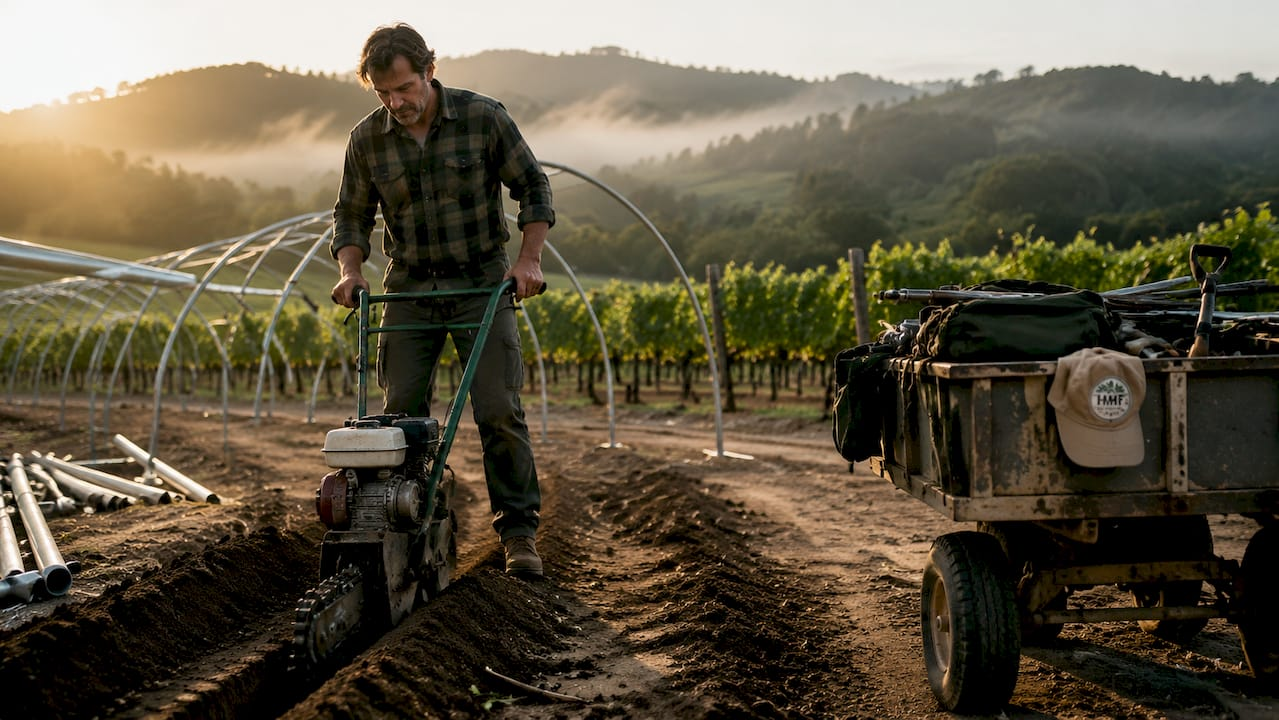
Farm supply distribution is defined as the organized system of procuring, storing, and delivering agricultural inputs, equipment, and products from manufacturers and wholesalers to farmers, retailers, and end-users across the agricultural value chain. This system is the backbone of modern agriculture. Without it, seeds, fertilizers, feed, and equipment never reach the farms that need them. The US farm supplies wholesale industry includes roughly 4,900 companies generating $206.1 billion annually, with the 20 largest firms controlling more than half of all revenue. That concentration tells you how much power sits at the distribution layer. At Halemalufarms, we see firsthand how a well-run distribution network directly enables sustainable, resilient farming, especially in island environments where supply chain gaps hit harder than anywhere else.
What is farm supply distribution and how does it work?
Farm supply distribution, known in the industry as agricultural supply logistics, moves products through a structured series of tiers before they reach a farm gate. Understanding each tier helps you spot where inefficiencies enter and where you can intervene.
Here is how the flow typically works:
- Manufacturer or producer creates the input: seed, fertilizer, feed, equipment, or bio-pesticide.
- Clearing and forwarding (C&F) agent receives bulk inventory from the manufacturer and holds it in a regional warehouse for redistribution.
- Distributor purchases from the C&F agent and covers a defined geographic territory, managing inventory, credit, and delivery scheduling.
- Retailer or farm cooperative buys from the distributor and sells directly to farmers, often providing last-mile delivery.
- Farmer receives the input, applies it, and produces food or livestock products that re-enter the supply chain as outputs.
Each tier adds cost, but it also adds reach. A manufacturer in Iowa cannot efficiently serve 10,000 small farms across rural Hawaii. Distributors and retailers solve that problem by absorbing logistics complexity at a local level.
Warehousing, transportation, and cold chain management are the three operational pillars of this system. Cold chain transport for perishable goods, including live feed cultures, biological inputs, and fresh produce, is significantly more expensive than ambient transport, requiring specialized refrigerated equipment and precise scheduling. One missed delivery window can spoil an entire batch.

Effective supply chain management aligns procurement schedules with planting calendars and seasonal demand cycles. This synchronization reduces waste and prevents the costly mismatch of having too much inventory before planting season and too little during it. Hub-and-spoke network designs, where a central warehouse feeds multiple smaller distribution points, are the most common structure for managing this complexity at scale.

Pro Tip: Map your distribution territory using actual road travel distances, not straight-line map measurements. Rural road travel distances are often 1.8 times the map radius, which means your delivery windows and fuel costs will be far higher than your initial estimates suggest.
What are the challenges and inefficiencies in farm supply distribution?
Farm product distribution networks face a set of recurring problems that no single technology or strategy has fully solved. Knowing these challenges is the first step toward building something better.
- Supply chain volatility. Between 2020 and 2025, the US farm supplies wholesaling industry grew at only 0.1% CAGR due to weather instability, logistics disruptions, and market fluctuations. Profit margins sit at just 3.7%, leaving almost no buffer for error.
- Cold chain costs and perishability. Biological inputs, live cultures, and fresh feed require refrigerated transport. Any breakdown in temperature control creates product loss and financial exposure.
- Geographic and infrastructure gaps. Rural farms, especially on islands like Hawaii, face limited road access, infrequent shipping schedules, and high freight costs. These barriers push up the price of every input a farmer buys.
- Poor route planning. Many distributors still plan routes using straight-line distances on a map, which consistently underestimates actual travel time and cost in rural areas.
- Disconnected supply chain stages. When procurement, warehousing, and delivery operate as separate silos rather than a unified system, errors multiply and costs compound.
“Effective agricultural supply chains require planning procurement, production, and distribution as linked stages to reduce waste and improve cost management.” — Agriculture Institute
The volatility problem is especially sharp for small and mid-sized distributors. With margins under 4%, a single weather event or shipping delay can wipe out a month of profit. Building redundancy into your network, through backup suppliers and multiple transport routes, is not optional. It is the price of staying operational.
How are modern technologies transforming farm supply distribution?
Smart agricultural supply chains using IoT, big data, and AI enhance production tracking, logistics efficiency, and quality supervision, reducing costs and improving sustainability outcomes. This is not a future trend. It is happening now, and the farms and distributors adopting these tools are pulling ahead fast.
| Technology | Primary Function | Distribution Benefit |
|---|---|---|
| IoT sensors | Real-time monitoring of temperature, humidity, and location | Prevents cold chain failures and product loss |
| AI demand forecasting | Predicts seasonal input needs based on historical and weather data | Reduces overstock and stockouts |
| Route optimization software | Calculates most efficient delivery paths using real road data | Cuts fuel costs and improves delivery windows |
| Blockchain traceability | Creates tamper-proof records of product origin and handling | Builds buyer trust and meets regulatory requirements |
| ERP and DMS platforms | Integrates order management, billing, and inventory in one system | Reduces manual errors and speeds up operations |
Distribution management software that integrates order management, route optimization, GPS tracking, and billing enhances operational efficiency and gives field staff real-time accountability. Mobile apps connected to a central dashboard mean a driver in the field and a manager in the office are always working from the same data.
At Halemalufarms, we are actively exploring tools like Rova Barn Ukko Robotics to integrate IoT and automation into our own supply and production systems. The goal is to reduce manual labor, improve monitoring accuracy, and build the kind of data trail that makes every distribution decision smarter.
Pro Tip: Do not wait until your network is large to adopt digital tools. A distribution management system (DMS) integrated from day one gives you clean data from the start, which is the foundation for every scaling decision you will make later.
How to create an effective farm supply distribution network
Building a farm supply distribution network from scratch requires deliberate design. Here is a practical framework we recommend:
- Define your territory and service circles. Start with a densely clustered area rather than spreading thin across a wide region. Densely clustered distribution nodes with 10 to 12 km service circles produce faster profitability and higher delivery frequency than widespread networks. Densification lowers per-delivery costs and builds stronger relationships with local retailers and farmers.
- Select your distribution tier structure. A 3-tier model connecting a C&F agent to distributors to retailers, supported by digital management tools, can achieve 95% market coverage within 12 to 18 months. Define each tier’s responsibilities, margins, and credit terms before you sign any agreements.
- Map territories using real road data. Use GIS mapping tools or route optimization software to calculate actual travel distances. Straight-line estimates will consistently underperform in rural and island environments.
- Integrate technology from day one. Deploy a DMS or ERP platform before your first delivery run. Set up GPS tracking, mobile order entry, and digital billing immediately. Retrofitting these systems later is far more expensive and disruptive.
- Build financial and credit management protocols. Distributors often extend credit to retailers, and retailers extend credit to farmers. Define credit limits, payment terms, and collection processes clearly. Thin margins in this industry mean a single bad debt can erase weeks of profit.
| Network Design Factor | Recommended Approach |
|---|---|
| Service circle size | 10 to 12 km radius per distribution node |
| Tier structure | 3-tier: C&F agent, distributor, retailer |
| Route planning method | Real road distance, not straight-line |
| Technology integration | DMS and ERP from day one |
| Market coverage target | 95% within 12 to 18 months |
For farms operating in challenging geographies like Hawaii, input cost hedging strategies from platforms like GrainStorm.ai offer a practical way to manage procurement cost volatility while building out your distribution network.
What is the role of farm supply distribution in promoting sustainable farming?
Efficient agricultural distribution does more than move products. It actively supports sustainability goals by reducing waste, enabling access to better inputs, and strengthening local food economies.
- Reduced food loss and waste. Optimized distribution networks reduce transport distances by 30% and quality degradation by 12%, according to research on perishable supply chains. Faster, more reliable delivery means fewer spoiled inputs and less wasted production.
- Access to sustainable inputs. A well-designed distribution network makes precision fertilizers, bio-pesticides, and organic amendments available to small farms that would otherwise rely on whatever the nearest general store stocks. Distribution is what makes sustainable input adoption practical, not just theoretical.
- Stronger local economies. Dense micro-service markets, where distributors serve tight geographic clusters, keep money circulating locally. Farmers spend less on freight, retailers earn more consistent margins, and communities build food security from the inside out.
- Lower carbon footprint. Route optimization and densification reduce the total miles driven per delivery. Fewer miles mean lower fuel consumption and lower emissions per unit of input delivered.
- Resilience against supply shocks. Local distribution networks with multiple supplier relationships are far more resilient than single-source supply chains. When one supplier faces a disruption, a well-networked distributor can pivot quickly.
At Halemalufarms, our AgroPort vision is built around exactly this model: a regional hub that combines hatchery operations, farm supply distribution, and local food production into one resilient, community-centered system.
Key takeaways
Farm supply distribution is the operational foundation that determines whether sustainable farming inputs reach the farms that need them, at the right time and cost.
| Point | Details |
|---|---|
| Distribution moves through tiers | A 3-tier model (C&F agent, distributor, retailer) is the most effective structure for scaling market coverage. |
| Densification beats sprawl | Service circles of 10 to 12 km produce faster profitability and lower per-delivery costs than wide, thin networks. |
| Technology is non-negotiable | IoT, AI, and DMS platforms reduce logistics costs, prevent cold chain failures, and improve delivery accuracy. |
| Sustainability is built in | Optimized networks cut transport distances by 30% and quality degradation by 12%, directly supporting sustainable farming goals. |
| Rural distances are deceptive | Actual road travel in rural areas averages 1.8 times the straight-line map distance, so always plan with real data. |
Why I think most farm distribution networks are built backwards
Here is something I have observed working in agricultural systems on Hawaii Island: most people design their distribution network by starting with the widest possible geographic reach and then trying to make it profitable. That is the wrong order. The networks that actually work start small, go deep, and earn their expansion.
Densification is not a compromise. It is a strategy. When you serve a tight cluster of farms and retailers with high frequency and reliability, you build the kind of trust that no marketing budget can buy. Farmers talk to each other. A distributor who shows up on time, every time, with the right product earns referrals that spread the network organically.
The technology piece matters too, but not in the way most people think. The value of IoT and AI is not the gadgetry. It is the data. Every sensor reading, every delivery timestamp, every order pattern feeds a picture of your network that lets you make better decisions next season than you did last season. That compounding improvement is where the real competitive advantage lives.
Climate volatility is only going to increase pressure on supply chains. The distributors who will thrive are the ones building agile, data-driven networks now, not the ones waiting for the market to stabilize. It will not stabilize. Adapt early, or adapt late at a much higher cost.
— kai
Farm supply solutions from Hale Malu Farms

Halemalufarms is building one of Hawaii’s most forward-thinking agricultural hubs, and our farm supply catalog reflects that mission directly. We stock and distribute supplies designed for sustainable, off-grid, and regenerative farming systems, from poultry feed and hatchery inputs to vertical growing supplies and aquaculture equipment. Every product we carry is selected with island farming conditions in mind. If you are building or refining your own distribution network, or simply need reliable farm supply delivery services on Hawaii Island, explore what we offer at Hale Malu Farms. We are here to support your operation, whether you are a homesteader, a commercial producer, or somewhere in between.
FAQ
What is farm supply distribution in simple terms?
Farm supply distribution is the system that moves agricultural inputs like seeds, feed, fertilizers, and equipment from manufacturers through wholesalers and distributors to farmers and retailers. It is the logistics layer that makes farming possible at scale.
How does a farm supply distribution network work?
A typical network uses a 3-tier structure: a clearing and forwarding agent holds bulk inventory, distributors cover defined territories, and retailers handle last-mile delivery to farmers. Digital tools like DMS and ERP platforms connect all three tiers in real time.
Why is farm supply distribution important for sustainable farming?
Efficient distribution reduces food loss, lowers transport emissions, and makes sustainable inputs like bio-pesticides and precision fertilizers accessible to small farms. Optimized networks can cut transport distances by 30% and reduce quality degradation by 12%.
What are the biggest challenges in agricultural supply logistics?
The main challenges are supply chain volatility from weather and market disruptions, high cold chain transport costs, geographic barriers in rural areas, and poor route planning based on straight-line rather than actual road distances.
How do IoT and AI improve farm supply chain management?
IoT sensors monitor temperature and location in real time to prevent cold chain failures, while AI forecasts seasonal demand and optimizes delivery routes. Together, these technologies reduce logistics costs and improve product quality at delivery.
Recommended
- Triple F Farm Produce –
- Hale Malu Agroport-Feed Farm supplies –
- Fresh Farm Eggs –
- Rova Barn Ukko Robotics –
Discover more from Your Local source for all things poultry
Subscribe to get the latest posts sent to your email.