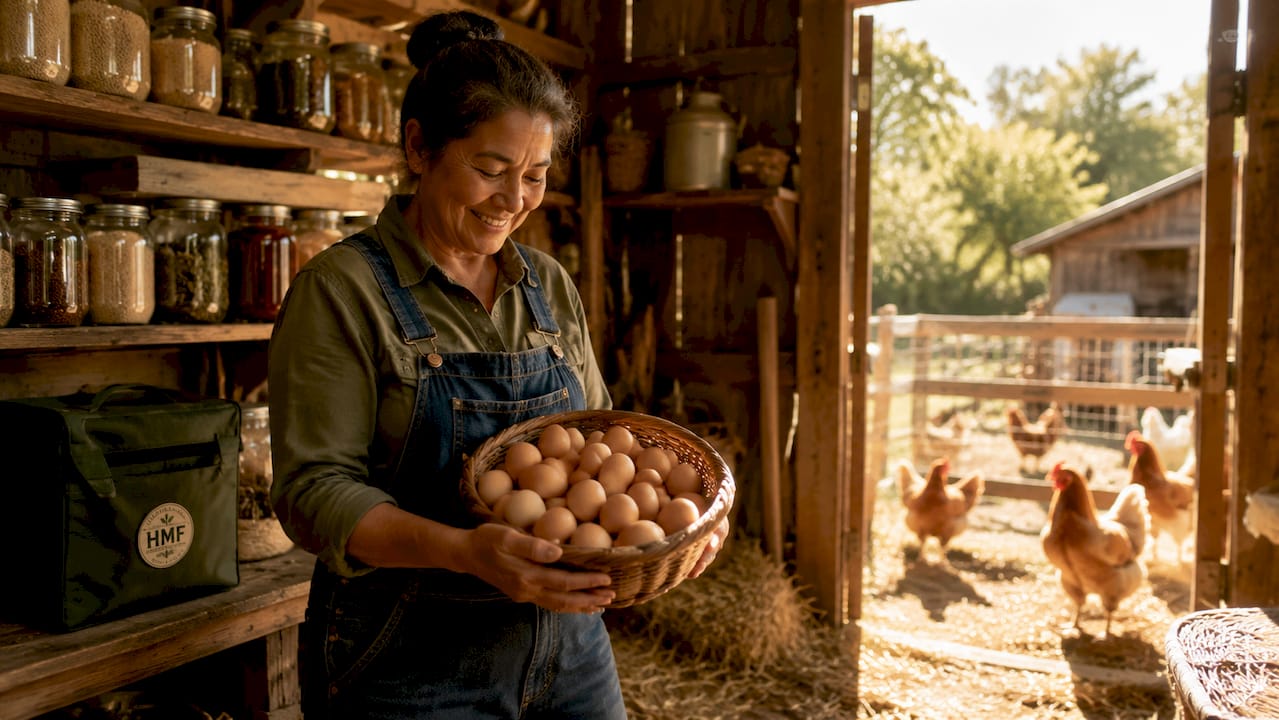
An automated egg barn is a poultry production facility that uses sensors, microcontrollers, and mechanical systems to handle feeding, ventilation, egg collection, and monitoring without constant human labor. When you build an automated egg barn small farm setup correctly, you cut daily chore time significantly while improving egg quality and flock health. The core technologies are more accessible than most homesteaders expect. Platforms like Home Assistant, microcontrollers like ESP32 and Raspberry Pi, and mechanical systems like rollaway nest boxes make this achievable on a real farm budget. This guide walks you through every layer of the system, from hardware to calibration.
How to build an automated egg barn on a small farm
The foundation of any automated egg barn is a layered architecture: edge controllers handle real-time tasks, a central computer manages data and automation logic, and mechanical systems do the physical work. Getting this structure right from the start saves you from expensive rewiring and reprogramming later.
A smart henhouse prototype used Raspberry Pi as the Modbus master and Arduino as the slave to control lights, ventilation, water, and feeding while collecting production data. That architecture is the gold standard for small farm egg production because it separates real-time control from higher-level automation logic cleanly.

Core hardware and software components
Here is what you need to get started:
- ESP32 microcontroller: Wi-Fi enabled, draws under 100µA in sleep mode, and handles door actuators, water sensors, and IR lamps. It is the workhorse for real-time barn control.
- Raspberry Pi: Runs Home Assistant, stores production data, hosts the user interface, and executes automation scripts written in YAML.
- Arduino: Acts as the Modbus slave, managing sensor polling and actuator commands from the Raspberry Pi master.
- 12V linear door actuators: Open and close coop doors on schedule or sensor trigger. Reliable, low cost, and easy to wire.
- Relays: Switch lamps, feeders, and water heaters on and off based on automation rules.
- Modbus protocol: The industrial communication standard that links your Arduino and Raspberry Pi using register maps and polling. It makes your system debuggable and modular.
- Home Assistant: The automation platform where you write YAML scripts to define rules like “close door 20 minutes after sunset” or “alert me if ammonia exceeds 10 ppm.”
Using Modbus register maps instead of ad-hoc sensor coding makes your system far easier to expand and troubleshoot. When something breaks at 2 a.m., you want a structured register map to query, not a tangle of custom code.
Pro Tip: Buy one extra ESP32 and one extra relay board before you start. Swapping a failed component in minutes beats waiting a week for shipping while your flock suffers.
What mechanical design works best for egg collection?
Electronics alone do not collect eggs. The mechanical design of your nest boxes and barn layout determines how well your automation actually performs day to day.

Rollaway nest box systems position the nest floor at a 12° slope so eggs roll away from hens immediately after laying. This protects eggs from pecking and breakage, and it moves them into a protected collection channel without any electronics required. That passive protection is the reason rollaway nests are the top choice for small-scale egg farming.
After any barn move, especially with mobile eggmobiles, you must re-level the nest floor. Even a small twist in the frame changes the effective slope and causes eggs to roll the wrong way or stop mid-channel. Check your slope with a digital level every time you relocate.
For egg transport across the barn, a central conveyor carries eggs from the nest channels to a collection point. Conveyor runs beyond 80 meters require segmented power drives to prevent belt sagging and maintain consistent egg transport. Most small farms stay well under that distance, so a single drive motor is sufficient.
| Mechanical Feature | Manual Approach | Automated Approach | Trade-off |
|---|---|---|---|
| Nest floor tilt | Fixed 12° slope, passive | Motorized actuator on timer | Actuator adds cost; passive works well for most setups |
| Egg collection | Hand gather from channel | Conveyor belt to central point | Conveyor requires leveling and power; saves significant labor |
| Door operation | Manual latch | 12V linear actuator + ESP32 | Actuator is reliable and low cost |
| Feeding | Manual fill | Relay-controlled autofeeder | Autofeeder requires calibration but reduces daily labor |
Pro Tip: For a mobile eggmobile, skip the conveyor and use the passive rollaway slope with a collection tray. It is simpler, lighter, and requires zero power for egg collection.
How do you control the environment inside an egg barn?
Air quality is the single biggest factor in hen health and egg production after nutrition. Poor ventilation causes ammonia buildup, respiratory disease, and dropped production rates. Automation fixes this by running fans at exactly the speed the air quality requires, not on a fixed schedule.
Automated ventilation systems use multi-parameter feedback loops with target thresholds and sensor response times as low as 5 seconds. The system reads multiple sensors simultaneously and adjusts fan speed in real time. This prevents the oscillation problem you get when a single sensor drives the whole system.
Here are the key sensors and their target ranges for a healthy flock:
- Ammonia sensor: Target below 8 ppm. Above 25 ppm causes eye and respiratory damage in hens.
- CO2 sensor: Target below 1,200 ppm. High CO2 signals poor air exchange and stresses birds.
- Temperature sensor: Varies by breed, but most layers perform best between 65°F and 75°F.
- Humidity sensor: Target around 58% relative humidity. Too high encourages mold and disease.
- Dust sensor: Target below 2.5 mg/m³. Dust irritates airways and carries pathogens.
Wire your sensors to the ESP32 and push readings to the Raspberry Pi every 30 seconds. Home Assistant then triggers fan speed changes, heater relays, or alert notifications based on the values it receives. Set alerts to your phone so you catch anomalies before they become flock health emergencies.
For thermal management, IR lamps controlled by temperature sensors keep young birds warm without running heat continuously. This is especially important in high-elevation farms like Halemalufarms near Volcano, Hawaiʻi, where nighttime temperatures drop unexpectedly.
Step-by-step setup for a small automated egg barn system
Follow this sequence to build your system without getting overwhelmed. Start small, prove each layer works, then expand.
- Procure hardware. Buy your ESP32, Raspberry Pi 4, Arduino Uno, 12V linear actuator, relay board, and sensors. Consider solar panels and a 12V battery bank if your barn is off-grid.
- Wire the ESP32 to your actuator and sensors. Test door open and close manually before writing any automation code.
- Set up Raspberry Pi with Home Assistant. Install the Modbus integration and configure your Arduino as a slave device with a register map for each sensor and actuator.
- Program dawn/dusk door timing. Use a sunrise/sunset astronomy library instead of fixed clock times. Set the door to close 15–20 minutes after sunset so all birds return safely before lockup.
- Test nest slope and conveyor level. Use a digital level on the nest floor. Adjust until you confirm eggs roll cleanly to the collection channel every time.
- Write Home Assistant YAML scripts. Define rules for ventilation, lighting schedules, water alerts, and feeder triggers.
- Run a 72-hour test with no birds. Simulate sensor readings and confirm every automation fires correctly.
- Introduce your flock and monitor closely for the first two weeks. Adjust thresholds based on real sensor data.
| Phase | Key Task | Milestone |
|---|---|---|
| Phase 1: Hardware | Wire ESP32, actuator, sensors | Door opens and closes on command |
| Phase 2: Software | Install Home Assistant, configure Modbus | Sensor data appears in dashboard |
| Phase 3: Mechanical | Level nests, test conveyor | Eggs roll cleanly to collection point |
| Phase 4: Calibration | Set dawn/dusk timing, sensor thresholds | All automations fire correctly in test |
| Phase 5: Live operation | Introduce flock, monitor data | Stable production with no manual intervention |
Pro Tip: Start with just door automation and water-level alerts. Get those working perfectly before adding feeders, ventilation control, and lighting. Complexity added too fast is the top reason small farm automation projects stall.
Can AI and computer vision improve your egg barn?
Yes, and the hardware is now affordable enough for small farms. Smart Coop 2.0 uses webcams running YOLOv8 models on embedded hardware to count eggs and detect predators, providing real-time alerts and reducing manual inspection entirely. That same approach works on a Raspberry Pi with a standard USB camera.
Here is how to think about AI deployment on a small farm:
- YOLOv8-nano model: Lightweight enough to run on a Raspberry Pi 4 in real time. Detects eggs in nest boxes and flags unusual objects like predators.
- Microphone integration: Sound-based predator detection catches threats that cameras miss in low light. Pair with a simple audio classifier trained on distress calls.
- Edge inference: Run the AI model locally on the Raspberry Pi. No cloud subscription, no latency, no privacy concerns.
- Alert integration: Connect detections to Home Assistant notifications. Get a phone alert with a camera snapshot the moment something unusual happens.
The biggest benefit of AI-powered egg counting is not convenience. It is data. When you know exactly how many eggs each nest box produces per day, you can spot a sick hen, a broken nest, or a production drop before it costs you real money.
Key takeaways
A well-built automated egg barn combines modular electronics, passive mechanical design, and real-time environmental monitoring to cut labor and protect flock health on any small farm.
| Point | Details |
|---|---|
| Start with proven architecture | Use ESP32 for edge control and Raspberry Pi with Home Assistant for automation logic. |
| Rollaway nests are your foundation | A 12° slope provides passive egg protection without any electronics required. |
| Environmental control is non-negotiable | Target ammonia below 8 ppm, CO2 below 1,200 ppm, and humidity around 58%. |
| Calibrate timing with real sunrise data | Use astronomy libraries for dawn/dusk scheduling to prevent door timing failures across seasons. |
| Add AI vision after basics are solid | YOLOv8-nano on a Raspberry Pi enables egg counting and predator detection at low cost. |
What i have learned building automated poultry systems
Here at Halemalufarms, we have been designing and testing automated poultry systems for years, and the lesson that keeps repeating itself is this: most failures are calibration failures, not hardware failures.
The seasonal timing drift problem is a perfect example. Farmers set a fixed door close time in summer and forget about it. By december, the door closes before half the flock returns. The fix takes five minutes in code, but the damage to flock safety and trust in the system takes weeks to repair.
The other thing I want you to understand is that environmental data is the real goldmine in a smart egg barn. Most people automate to reduce labor, which is valid. But the long-term value is the production data you accumulate. When you have 90 days of ammonia, temperature, humidity, and egg count data, you can see exactly which conditions produce your best laying days. That is information no manual operation can generate.
My honest advice: resist the urge to automate everything at once. Build the door, water sensor, and one environmental alert first. Live with that for 30 days. You will learn more about your specific barn’s behavior in that month than any guide can teach you. Then add the next layer. Modular design is not just a technical choice. It is a mindset that keeps your system maintainable and your flock safe when something inevitably needs adjustment.
— kai
Ready to build your egg barn? Halemalufarms has you covered
At Halemalufarms, we stock everything you need to get your small farm egg production system running. From heritage breed layer hens proven to thrive in automated barn environments, to rollaway nest boxes designed for efficient collection, we have sourced the right equipment for real farms. Our feed and supplies are selected specifically for layer hens in small-scale production setups.

Whether you are starting your first automated coop or scaling up to a full egg production facility, our team is here to help you choose the right breeds, equipment, and supplies. Visit the Halemalufarms shop and take the next step toward a productive, lower-labor egg barn that works for your land and your life.
FAQ
What microcontroller is best for a small egg barn?
The ESP32 is the top choice for small farm egg barn automation. It offers Wi-Fi connectivity, low power consumption under 100µA in sleep mode, and enough GPIO pins to handle doors, sensors, and relays.
How steep should rollaway nest box floors be?
Rollaway nest floors should slope at 12° to roll eggs cleanly into the collection channel. Re-level the floor after every barn move to maintain this angle.
What air quality targets should i set for my hens?
Target ammonia below 8 ppm, CO2 below 1,200 ppm, relative humidity around 58%, and dust below 2.5 mg/m³ for healthy laying hens and consistent egg production.
Can i run an automated egg barn off-grid?
Yes. An ESP32 draws under 100µA in sleep mode, and a Raspberry Pi 4 runs on roughly 5 watts. A modest solar panel and 12V battery bank can power the full control system reliably.
How does home assistant connect to my barn hardware?
Home Assistant runs on the Raspberry Pi and connects to Arduino via the Modbus protocol over Ethernet. You write YAML automation scripts that read sensor values and trigger actuators based on defined thresholds.
Recommended
- 370 Egg Homesteader Incubator – Surehatch Auto Digital Egg Incubator – Your Local source for all things poultry
- Hatchery Equipment – Your Local source for all things poultry
- Hale Malu Farms – Your Local source for all things poultry
- Surehatch – Your Local source for all things poultry
Discover more from Your Local source for all things poultry
Subscribe to get the latest posts sent to your email.